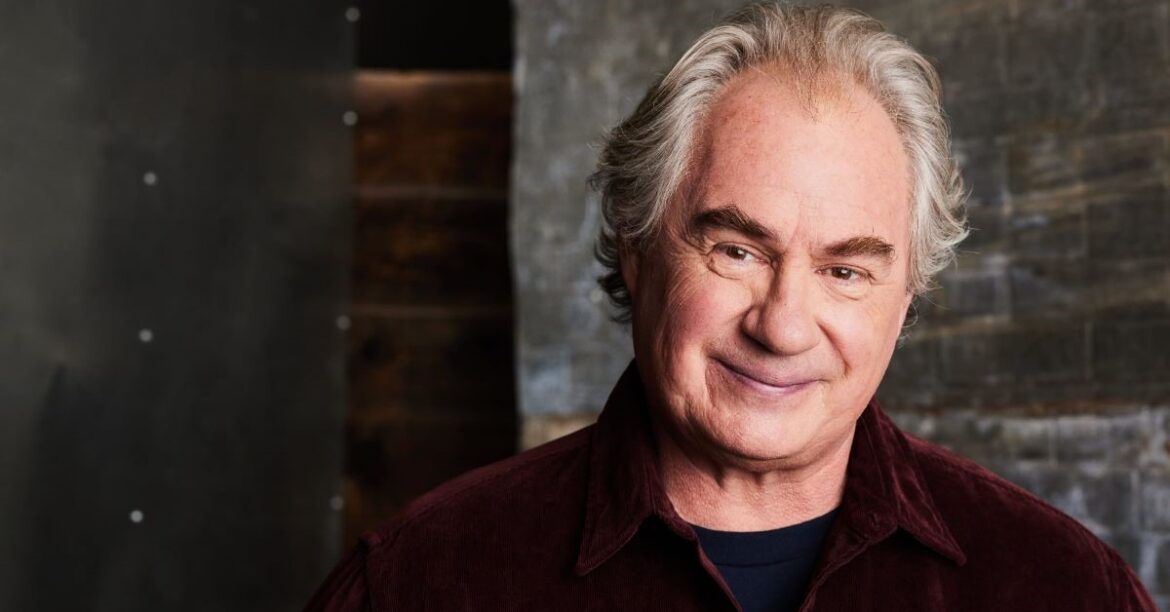
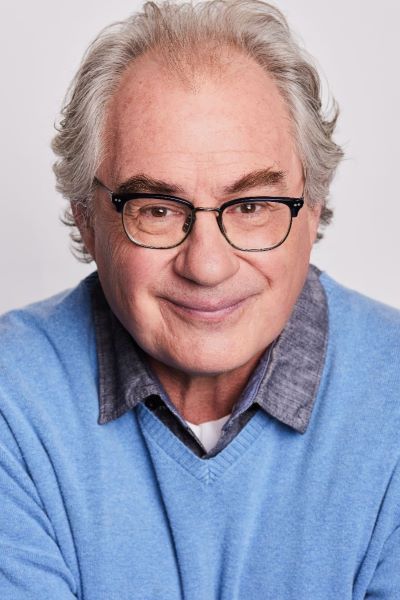
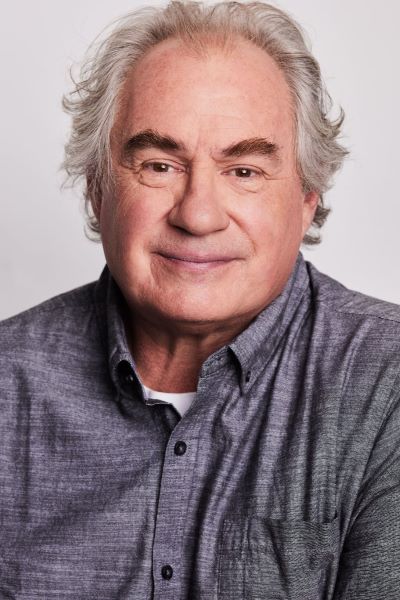
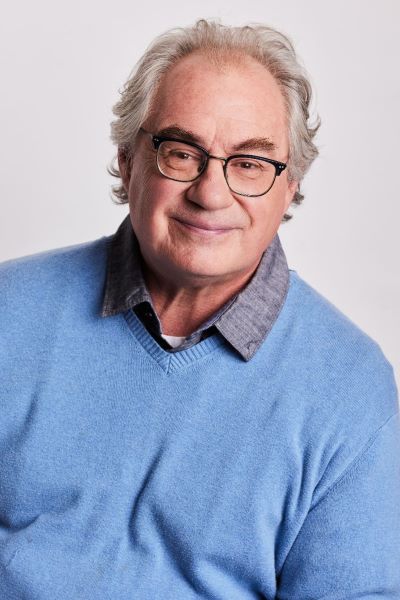
Star Trek fans know John Billingsley best for his iconic and memorable portrayal of the Denobulan chief medical officer, Dr. Phlox, aboard the Enterprise NX-01. Phlox was a delightful presence aboard a ship often divided along species or cultural lines. His universally welcoming and avidly curious personality provided a charmingly objective perspective on the conflicts and dilemmas this crew encountered in its travels.
In 2022, Billingsley founded the Trek Talks event as an annual fundraiser for the Hollywood Food Coalition. In this exclusive interview, he describes the inspiring generosity of the Trek community in coming together to combine various talents and skills to make the event happen.
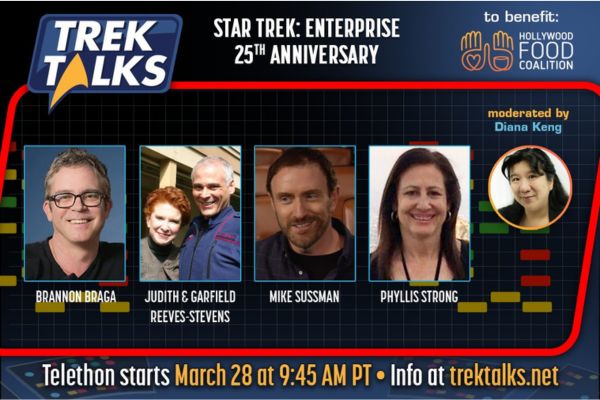
With Star Trek: Enterprise celebrating the 25th anniversary of its premiere, Trek Talks 5 is especially significant to Billingsley, who enjoys his role as co-host, sharing the duties with Star Trek: Prodigy‘s Bonnie Gordon.
Let’s get down to business. Tell me about Trek Talks!
Huzzah! Trek Talks is an eight-hour-long, digital, Jerry Lewis-esque telethon to raise money for Hollywood Food Coalition, which is a terrific social service organization in Los Angeles devoted to bringing food and necessary emergency supplies to people in need throughout the Southland.
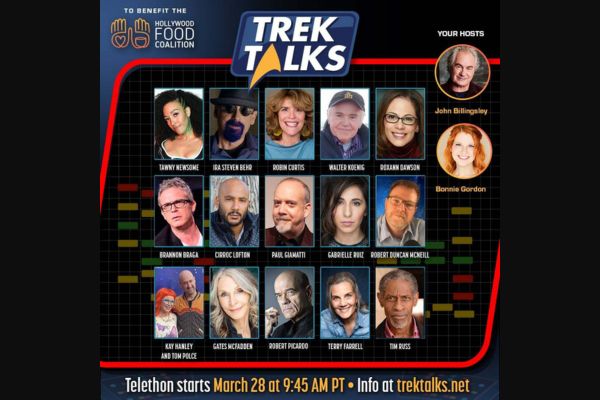
We’ve been doing it for five years. This is the fifth incarnation of Trek Talks. Bonnie Gordon and I are the hosts, and it’s panels, conversations and short videos all about Trek! Celebrities! Behind-the-scenes talent! Writers, composers, make-up artists… you name it.
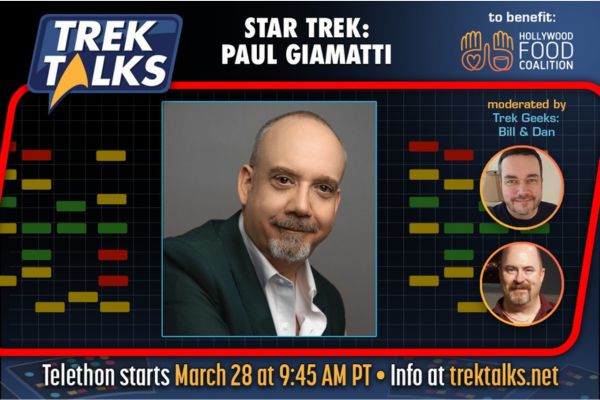
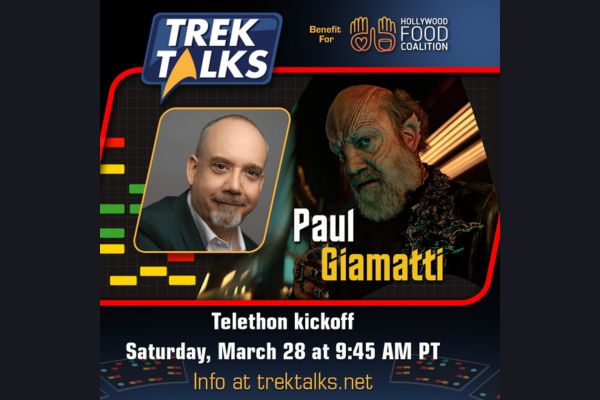
It’s been hugely successful. We’ve raised over half a million dollars for the Food Coalition since we started doing this. We’ve got some amazing guests coming on this year, highlighted by Paul Giamatti, who has generously agreed to give us a standalone interview.
I’ve got an amazing group of dear friends and podcast hosts who produce the show. I’m merely the figurehead at this point, just the pretty face on camera.
I call it “a convention without pants” because I do not wear pants, and it is a way of suggesting that for folks who may not be able to go to a convention, we bring it right into your living room, and you don’t even have to be dressed to enjoy it.
Having been the “talent” at live conventions, how do you think the panels at Trek Talks compare to in-person events?
One thing that’s really cool is you get some interesting combinations that you do not normally get at the conventions. For one thing, not everybody necessarily goes to conventions, and, outside of the biggest convention in Vegas every year, the smaller conventions aren’t attracting a ton of guests. We have 40-50 guests every year, and we intentionally try and pair them in ways that are unusual or interesting.
It’s going to be unlike what your normal convention experience is. Not to mention the fact that it doesn’t cost you thousands of dollars to get there, get a hotel room, and the sandwiches that you’d buy are inedible, whereas you’re going to be able to go to your refrigerator to make a sandwich that’s probably going to be delicious.
How did the first Trek Talks come about?
It was interesting because I was doing an interview. Now, I was very heavily involved with the Food Coalition. For a brief period of time, I was actually a volunteer co-executive director, so this has been a very deep passion project of mine for a long time. I was talking to Bill Smith and Dan Davidson of Trek Geeks about the work, and they said in passing that they had done a one-night conversation with Jonathan Frakes — an hour or so — to raise money for Feeding America, and they’d made $5000.
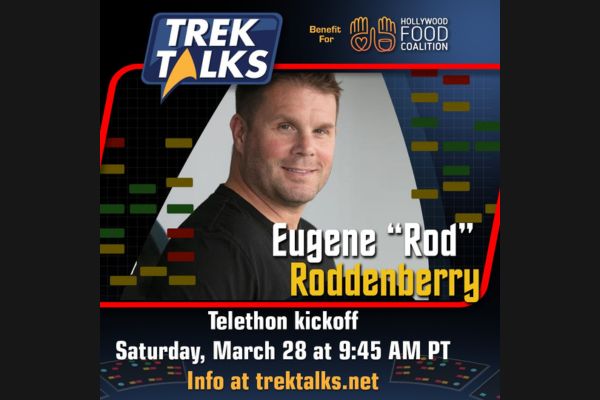
And I thought, “Huh. Y’know, I wonder whether or not one could expand on that notion, and actually have a day-long event, kind of mirror a convention, and do it for Hollywood Food Coalition?” And they were so game and jumped right in. We found some other folks, notably John Champion from Roddenberry Podcasts, who was a great conduit to Rod Roddenberry, who has been one of our foundational donors and really has allowed us to do this work. We match his annual donation.
And to our surprise, I think, everybody that we asked said yes. Everybody we asked who said yes showed up. It went without a technical hitch. It was one of those rare instances in life where you think, “Oh! Haha! The train did not crash! Let’s do it again!”
How has the event grown since its first edition?
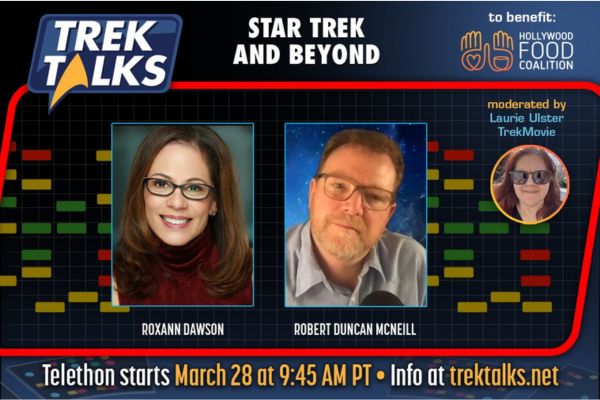
We started interviewing a lot of people who watched to get their feedback and input. What worked. What didn’t work. We found a number of people liked it so much, they actually wanted to join the team. So we expanded the team, notably Laurie Ulster joined us. I could go on and on about all the various and sundry producers… I don’t think I can remember them all because there are about 15 people now who make this event happen, who bring all sorts of expertise to the table. Earl Green is essentially our line producer who makes the trains run on time on the day.
I have kind of stepped back, so I am emeritus and have the great joy of getting to see this thing — that I sort of thought in passing MAYBE could work — now cement itself as I think the biggest Trek-themed charity event of the year. I could be wrong about that. That’s what somebody said to me. I don’t know if that’s true, but what the hell, maybe it is!
The first Trek Talks happened just as we were coming out of COVID. Do you think that played a part in the success of Trek Talks?
A few things happened simultaneously during COVID because the need exploded. A lot of people in the social services community and in Los Angeles really had their eyes opened to the centrality and the importance of food provided on a consistent and regular basis.
Because money was coming in from the federal government — we had a beneficent federal government then, instead of what we’ve got now — we were able to enjoy the support of the government and expand the nature of our programming. We started sharing and rescuing more and more food.
We’d always had a very successful nightly meal program. We grew to the point where we were rescuing over two million — we now rescue almost three million — pounds of food a year to share with about 100 to 150 other social service organizations. Because I felt that we were at a point where the mission and the vision of the organization was big enough to turn to a national audience and say, “See what we’re doing,” I thought something like Trek Talks would be valid.
I feel like now the message for what it is we do has relevance because we can say, as one of the biggest cities in the country, the programming we’re doing actually has something to offer, to teach to other cities about how they can expand food rescue and food sharing too.
So that was some of the thinking behind “Yeah, let’s give this a whack,” post-COVID. We’ve grown. We’ve got a bigger message.
How do the spirit of Star Trek and the mission of the Hollywood Food Coalition align in Trek Talks?
For one thing, what appealed to me about the Hollywood Food Coalition above and beyond its particular mission was the concept of coalition-building, which is at the essence of what Star Trek is about. “Infinite Diversity in Infinite Combinations” and the nature of what it takes to build a Federation that says, “Here we are, together. All of our skills, all of our abilities. All of us have a role to play in making something bigger and more positive and optimistic than we are individually.”
This was always a very volunteer-centred organization, so I didn’t change its structure or its mission, but I definitely thought I want to help expand and elbow out the possibilities for how people can get involved. In doing so, I also wanted to expand the possibilities of what we could do on the ground because the more we work with other social services organizations, the more possibilities exist for us to figure out how to work together in bigger ways.
This is something that’s tricky in a not-for-profit world. We’ve all got our dukes up, looking for our individual funding source, worried about the bottom line on our budget. But the bigger the mission and the more you’re working together with other groups, the more you’re creating for a community of potential funders a sense that what you’re doing is BIGGER. People want to fund that. Y’know? People want to fund a rocket to the moon, the great adventure. People want to fund big solutions.
And that’s where I think there’s a crossover between Star Trek and its optimism and ambition and what appealed to me about the Coalition.
Star Trek is as much aspirational as it is inspirational because it says that we can get there eventually.
Absolutely. It’s interesting because my tendency is to go back and say, “Yes, but…” I’m a pragmatist. How do you get from here to there? From A to B? What is it that allows you to take the next step and the next step?
Star Trek has always had to [gloss over that] a little bit. How did we get to the Federation? Because it wants to first exist as a “Yes, we can!” and not necessarily a “Here’s how we do it.” The “Here’s how we do it” is really, really challenging. It comes down to what we each of us individually feel like we can do in a small way in our own communities.
In a certain sense, the Star Trek vision is “Keep your eye on what you can do, where you are, and trust that out of that will come this.” It’s a tricky leap.
Speaking of tricky leaps, on the occasion of the 25th anniversary, how do you feel Star Trek: Enterprise‘s path reflects our journey to becoming our better selves?
If there was any show that I’d be curious to see, it would be the show that [answers] “How did we get to a point where we were able to set aside all of the us-against-the-other-ism that drives us now to the point that we could agree as a planet on a planet-centric push [into space]?”
Yes, our show largely revolved around the tensions that existed between us and the Vulcans and other interstellar species, but the given has always been that we have put our differences aside. It is the one thing that, unfortunately, is almost impossible to address. If we knew how we could get from the mess we’re in now to a place where we could have a Federation of Planets…
Some of the Star Trek questions that have revolved a little bit in our show and subsequent iterations have been a little bit darker than the original show because we live in a darker world. Certainly, our third season was a response to 9/11 and even a little too xenophobic for my taste. It’s the unanswerable question for Star Trek.
IDIC is easy to say, but living it is harder.
For me, that’s where the Food Coalition has merit and a side effort we engage in, something called Trek-tivism, which is a way to help celebrate the things that people are doing in their communities to make a difference.
I’m not a religious person, but that adage in the Bible: “Brighten the corner where you are” is the only thing that we have functional control over. You cannot assume responsibility for change in the world, but you can certainly assume some responsibility for making a difference in your hometown. That’s where we have to look. Especially because the federal government is clearly abdicating its responsibility to our country, to an us-ness.
We are going to have to find a way to take care of the people in our immediate orbit more and more and more. I wish that were not the case. But the good thing that comes out of that it impels us and encourages us to step up. The stepping up is the answer.
Trek Talks kicks off at 9:45 am PT/12:45 pm ET on YouTube this Saturday, March 28