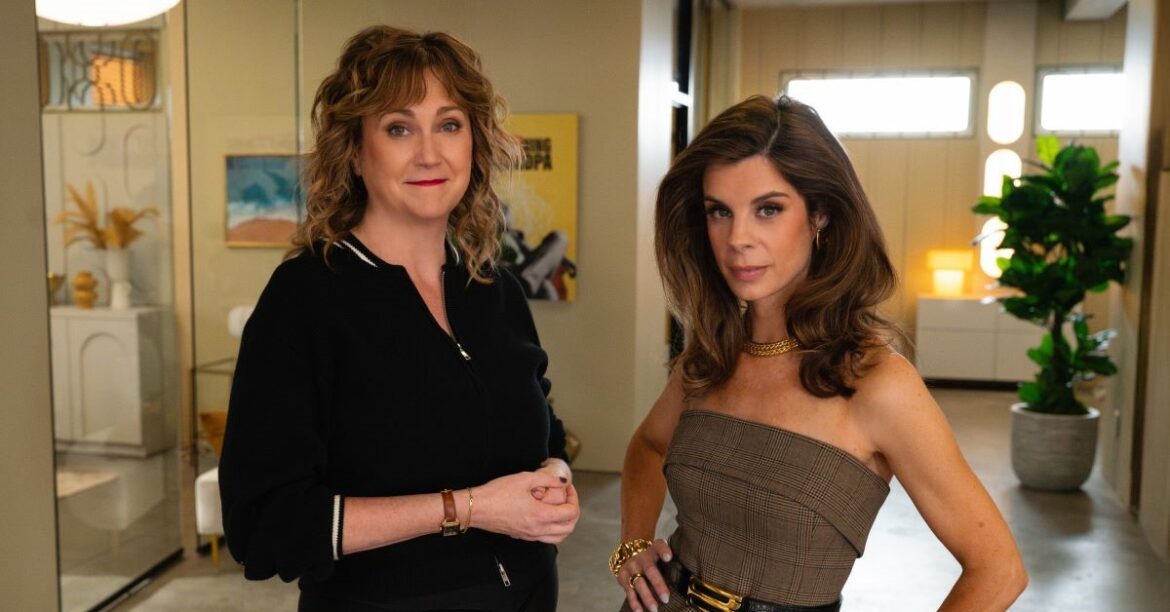
Two lauded baronesses of Canadian comedy, Jennifer Whalen and Meredith MacNeill, invariably and effortlessly splash out with impeccably crafted comedy, leaving thoughtful discussion in their wake with every project they touch.
Their newest critically acclaimed series, Small Achievable Goals (which, interestingly, abbreviates to SAG), spotlights menopause and its effects on women, their relationships, and their careers. Small Achievable Goals returns with Season 2 on January 6 on CBC and CBC Gem.
We leapt at the chance to interview the pair about continuing to address this challenging and misunderstood aspect of women’s lives in emotionally honest yet genuinely hilarious contexts. They did not disappoint.
[The following interview has been edited for length and clarity.]
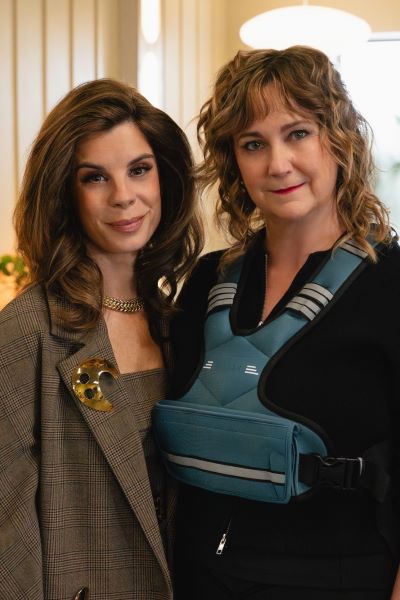
What has been the response to how Small Achievable Goals says the quiet part loud and makes it funny?
JW: It’s been touching, amazing, and overwhelming. It’s been very powerful for people to hear the previously unarticulated. It ranges from “Thank you for the laugh,” to “I was in a dark place, and this really helped me.” So that’s been great. It’s been surprising to me that men have been, “Oh my god, thank you for saying some of this stuff.” It’s been lovely, and you always hope that, as an artist, you make something that resonates with people. I feel very happy that it seems to be doing that.
MM: Jenn and I always try to make content that starts conversations, so it feels like… I LOVE CHATTIN’. I love a chat! Creating content where we hope for that to happen has been so wonderful, whether it’s getting stopped on the street and having a conversation, the social media presence on Instagram, also witnessing and hearing other women talking about their stories has been so personally helpful and good. If we’re part of a movement, we’re grateful for that.
How do you feel your characters, Julie and Kris, approach the challenges of life differently, especially in Season 2?
JW: Julie is very in her head. Julie is very “think it through.” Kris is way more “feel it through.” Definitely in Season 1, Julie, as a person who has tried to play the game of how straight male society tells you how to succeed in business, has done all those things, and it hasn’t worked for her. In Season 2, she’s trying to align herself more with what she feels is right versus this thing, which has mixed results for her. [Kris and Julie] do look at it in different ways. Julie looks at it through a traditional this-is-what-happens-in-an-office lens, and Kris is more wide open to how things should be in the workplace.
MM: In Season 1, Kris has learned very quickly about the emotional landscape and the patriarchy of how one is expected to behave at work. I think in Season 2, because of her anxiety and depression, which is perimenopause-induced, the way she learns to behave is very different because of the shame she carries because of it. With the new boss coming in, she’s told very quickly, “Keep it tight. Lock down your emotions,” which is very hard for Kris. This season, she’s about what it is to hold everything in and live with shame [about] the mental health, AND get through the workday. You also see how Julie’s dealing with menopause and HRT; [both] their personal lives are coming into work, and it’s just not happening. They both betray themselves, I would say, personally and at work.
There’s a very different dynamic in Season 2 with Amanda King’s presence in her position of power. Can you speak to her role and her relationship with your characters?
MM: It was really important to us to show that, of course, you can have — as in Season 1 — a male bully, but some of my biggest bullies have been females. We shouldn’t shy away from talking about how the patriarchy affects us all, including men, but we also shouldn’t shy away from the fact that the biggest betrayal can come from another woman. And then, also, really having a deep understanding of what makes an Amanda King.
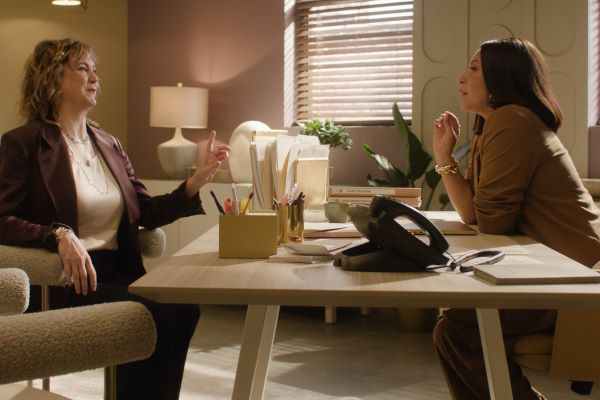
To get ahead in business, what is it that you do to become that type of person? Who are you to become that? That’s been helpful to explore the Amanda King character and have that dynamic, and also have menopause put on top of it — three different experiences of it. What does it look like? And where does it all come from? What does bullying look like from women? What does bullying look like from men?
With the many different relationships your characters deal with as they navigate menopause, where do they find space to love themselves?
JW: That is a hard thing in menopause because it throws up everything that you knew about yourself and everything that you thought was true in so many ways. Physically, emotionally, whatever. You have to relearn to love yourself. That’s what they’re trying to do. For Julie, her relationship with her husband is so important. It’s her grounding force. Her relationship with him and how she is with him is very different than how she is at work. And, as the season goes on, when that gets wobbly for her, she’s really destabilized.
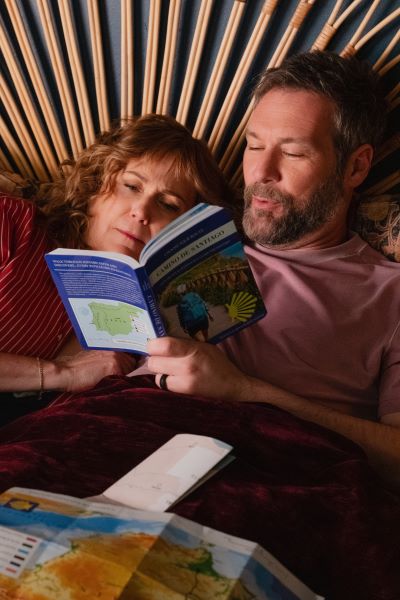
She also loves herself when she’s feeling like she’s doing good work, so when that is challenged or threatened, that’s really hard for her because that’s a way that she feels value about herself. And then her third pillar, which also gets challenged, is her friendship with Kris. They are this unlikely, odd couple duo, and she found somebody that she could really talk to in Kris. So in this season, when they’re not really connecting, it’s really, really difficult for her. She’s definitely looking for love and trying to stabilize the ways that she gets it.
What about Kris?
MM: For Kris, again, she loses all her pillars, too, and because of anxiety and depression, which then leads to suicidal ideation [spawning from things like] if you’re not showing up for your kid the way that you want and also women constantly feeling like they’re the problem and not knowing how to advocate for mental health is really important. You see that in the first episode, in the shower: She’s using the anxiety podcast, this relationship to water, the relationship to wanting to disappear, the relationship to being a terrible parent, where she can’t show up for a birthday party.
The level that anxiety plays and this language we have around it is still confusing for me, as Meredith, and as a parent. I think all of us are exploring, or trying to continue to explore, mental health as a community. And then what does it look like in menopause? What does it look like with your relationship to your child? And how do you self-advocate in those arenas?
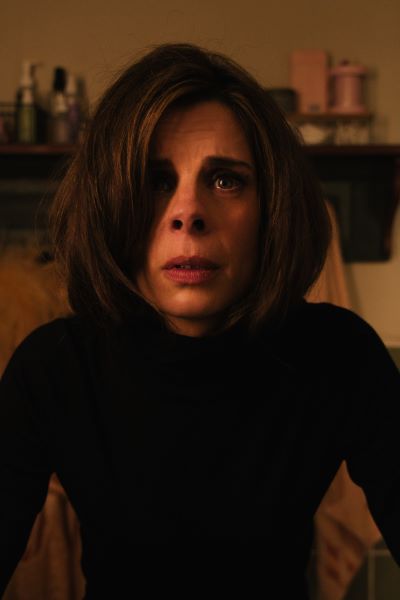
The first instinct for Kris is to hide in water and to not show their child [that they’re] crying. “I will do this. I will show up at the birthday party.” But I don’t even know that that’s right. What does it look like if she just said, “Mom’s going through a hard time. Mom’s struggling with my mental health.”
It is so funny when we share the scripts or when we get notes. What is a good parent? What is a bad parent? And the stereotypes that come with that and with mental health? Then Kris is told, much like Julie, to “keep it in tight,” to “hold it together.” The shame of keeping it in tight [can cause] cognitive dissonance and separation. It causes her to separate from Julie, from her work, even her relationship with her child.
With Small Achievable Goals, do you feel that you have achieved yours, and do you have more?
JW: I think that getting a show on the air about this subject matter was a BIG, maybe-not-achievable goal that we achieved, so I’m gonna give myself a massive break. We’ve achieved a lot of what we wanted to talk about this season — which is huge and great — and stuck to our guns, which is not always easy. We achieved a goal for ourselves, which was to make a comedy that was also moving and had a lot of heart in it. I think we achieved that. We wanted women to feel seen, and I hope we’ve achieved that.
MM: God, this show sounds great!
JW: We were like, “Menopause. Nobody knows the answers. We don’t know the answers.” We wanted to raise the questions but leave it open-ended so that the audience can maybe just be able to talk about it and come to their own conclusions, ’cause who really knows? It’s going to be different for every woman. I think we did that!
Small Achievable Goals Season 2 premieres on January 6 on CBC and CBC Gem.